

Table of Contents
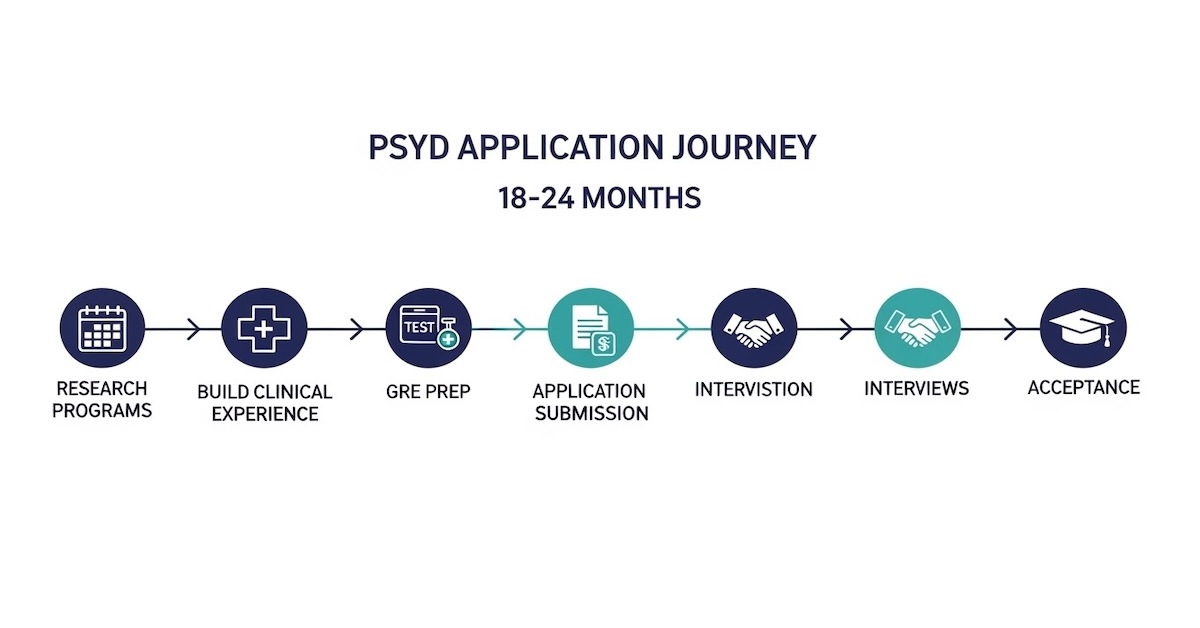
Applying to Doctor of Psychology (PsyD) programs represents one of the most significant commitments in your academic journey, requiring strategic planning across 18-24 months before your intended start date. Unlike many graduate programs, PsyD applications demand extensive clinical experience, careful program research, and meticulous attention to deadlines that can make or break your chances of acceptance.
With PsyD program acceptance rates varying widely—competitive programs often falling below 20%—understanding the PsyD application timeline becomes critical to your success. Clinical psychologists earn a median salary of $96,100, with specialized practitioners commanding substantially higher compensation, and the profession projects robust 6% growth through 2033. However, reaching this rewarding career begins with successfully navigating a complex admissions process that starts much earlier than most applicants realize.
This comprehensive month-by-month guide walks you through every phase of the PsyD application journey, from initial program research to final acceptance and orientation. Whether you’re a college junior just beginning to explore doctoral programs or a recent graduate planning your application strategy, this timeline provides the roadmap you need to build a competitive application that stands out to admissions committees.
Ready to Start Your PsyD Journey?
Connect with accredited PsyD programs that match your career goals and interests.
Understanding the PsyD Application Timeline
The Standard Application Cycle
Most APA-accredited PsyD programs operate on a remarkably consistent admissions calendar. Understanding this timeline helps you plan backwards from critical deadlines to ensure every component of your application receives adequate attention and development.
The typical PsyD application cycle follows this pattern:
| Timeline Phase | Key Activities | Critical Deadlines |
|---|---|---|
| Application Opens | PsychologyCAS portal becomes available | Early-Mid September |
| Application Deadline | Submit all materials | December 1-15 (most programs) |
| Interview Invitations | Programs contact selected candidates | Mid-December through February |
| Interviews | Campus visits or virtual interviews | January – February |
| Admission Decisions | Programs release acceptances | March – Early April |
| Decision Deadline | Accept the offer and submit the deposit | April 15 (APA standard) |
| Program Start | Orientation and first classes | August – September |
This standardized timeline exists because the American Psychological Association’s Council on Graduate Departments of Psychology established April 15 as the universal deadline for decisions for APA-accredited programs. This allows programs to manage waitlists effectively and ensures prospective students have adequate time to make informed decisions about multiple offers.
Why Start 18-24 Months Early?
The extended preparation timeline accounts for multiple overlapping requirements that cannot be rushed without compromising application quality. Competitive PsyD applicants typically need to accumulate 500-1,000+ clinical experience hours, which requires 12-18 months of consistent work. Additionally, you need time for meaningful research involvement, cultivating faculty relationships for strong recommendation letters, GRE preparation where required, and iterative personal statement development.
Research demonstrates that applicants who begin preparation 18-24 months before deadlines report significantly lower stress levels, stronger application components, and higher acceptance rates than those who compress preparation into the final six months.
18-24 Months Before Application: Foundation Phase
Spring/Early Summer (24-18 Months Out)
Research PsyD Programs Thoroughly
Begin by identifying 15-20 programs that align with your clinical interests, geographic preferences, and career goals. Prioritize APA-accredited programs exclusively, as non-accredited programs create insurmountable licensure barriers in most states.
Evaluate programs using these essential criteria:
- Training Model and Philosophy: PsyD programs emphasize the practitioner-scholar model, devoting approximately 70% of the curriculum to clinical training rather than research. However, significant variation exists between programs in research requirements and the intensity of clinical focus.
- Clinical Training Opportunities: Examine practicum placement sites, specialty training tracks, and internship match rates. Top programs aim for high APA-accredited internship match rates, often exceeding 90%, with the most competitive programs approaching or reaching 100%.
- Specialization Options: If you have specific interests in areas such as forensic psychology, health psychology, child/adolescent work, or neuropsychology, identify programs that offer formal specialization tracks.
- Financial Considerations: Most PsyD programs are not fully funded, resulting in typical debt loads of $150,000- $250,000. Identify the handful of programs offering partial or complete funding options.
- Outcome Data: Programs must publish graduation rates, average time to degree completion, internship match rates, and licensure pass rates. Competitive programs demonstrate graduation rates above 80% and first-time licensure pass rates exceeding 90%.
⚠️ Important Note: Deviating significantly from standard December deadlines may signal potential accreditation concerns or non-standard program structures. Always verify a program’s APA accreditation status before investing time in the application.
Begin Accumulating Clinical Experience
Clinical experience represents the single most important PsyD application component. Programs seek candidates who demonstrate a genuine understanding of clinical work through sustained, meaningful client contact. While competitive applicants typically accumulate 500-1,000+ hours, quality supersedes quantity.
Valuable entry-level clinical experiences include:
- Crisis Hotline Counseling: Provides immediate exposure to acute mental health needs and crisis intervention techniques
- Psychiatric Hospital Volunteering: Offers multidisciplinary team experience and exposure to severe mental illness
- Registered Behavior Technician Positions: Structured training in evidence-based interventions, particularly for autism spectrum disorders
- Community Mental Health Center Roles: Diverse populations and presenting problems with underserved communities
- Research Assistant in Clinical Labs: Combines research literacy with clinical observation
Prioritize positions that offer direct client interaction, clinical supervision, and increased responsibility over time. A two-year commitment as a crisis counselor with documented skill progression proves far more valuable than brief stints in multiple unrelated positions.
🎓 Finding the Right PsyD Program
Not sure which programs align with your interests and goals? Our comprehensive database helps you compare APA-accredited PsyD programs by specialization, location, and outcomes.
Initiate GRE Preparation (If Required)
Many APA-accredited PsyD programs have made the GRE optional or eliminated it, though the exact percentage varies. However, competitive programs, including several top-ranked institutions, continue to require or strongly recommend GRE scores.
For programs requiring the GRE, competitive scores typically fall in the 50th-60th percentile or higher on verbal and quantitative sections. Begin preparation early, as most students require 2-3 months of consistent study to achieve target scores. Plan to test by September or early October of your application year, allowing time for retakes if necessary (minimum 21-day waiting period between attempts).
Shadow Practicing Psychologists
Arrange shadowing experiences with licensed psychologists in various practice settings—private practice, hospitals, community mental health centers, schools, and forensic settings. These experiences serve dual purposes: confirming your career direction and providing concrete examples for your personal statement, which demonstrate an informed career choice.
Document these experiences systematically. Record dates, hours, settings, populations observed, assessment and intervention approaches witnessed, and reflections on what you learned. This documentation becomes invaluable when drafting application essays months later.
12-15 Months Before Application: Building Your Profile
Summer (15-12 Months Out)
Complete GRE Testing
If required by your target programs, take the GRE in August or early September. Taking the exam during the summer, when other academic commitments are lighter, typically yields better performance than attempting it during busy academic semesters. Score reporting usually takes 10-15 days, so plan accordingly.
Visit Campuses and Attend Information Sessions
If financially feasible, visit top-choice programs during the summer. Many programs offer virtual information sessions year-round, making geographic barriers less prohibitive. During visits, note program culture, student-faculty interactions, clinical training facilities, and community context. Request meetings with current students who provide unfiltered perspectives on program strengths and challenges.
Virtual tours have become sophisticated, offering 360-degree views of facilities, student testimonials, and faculty presentations. While not replacing in-person visits, these resources provide substantial insight into program environments.
Continue Clinical Experience Development
By this point, you should be actively engaged in consistent clinical or research work, accumulating meaningful hours. If your experience remains limited, prioritize immediate placement in relevant positions. Admissions committees can identify rushed last-minute experience attempts versus sustained commitment.
Draft Preliminary Personal Statement
Begin drafting the personal statement during the summer,r when academic pressures are reduced. Initial drafts should focus on authentic narrative development rather than polished prose. Address these core elements:
- Your pathway to clinical psychology and what sparked your interest
- Formative experiences demonstrating commitment to the field
- Specific populations or clinical issues drawing your interest
- How your background prepares you for doctoral training
- Why you are pursuing a PsyD over other psychology degree
Expect to complete 8-12 drafts before finalizing your statement. Each target program requires customization, which demonstrates a specific fit with that program’s training model, clinical opportunities, and faculty expertise.
| Personal Statement Element | What to Include | What to Avoid |
|---|---|---|
| Opening Hook | Specific anecdote showing your interest | Generic statements about “wanting to help people.” |
| Clinical Experience | Concrete examples with reflection on growth | Simply listing experiences without insight |
| Research Background | Your role and what you learned | Excessive technical details about projects |
| Program Fit | Specific faculty, clinics, or training tracks | Generic praise that could apply anywhere |
| Future Goals | Realistic career aspirations with specifics | Overly ambitious or vague statements |
6-9 Months Before Application: Preparation Intensifies
September (9 Months Out)
Finalize Program List
Narrow your research to 8-15 programs representing realistic reaches, targets, and safety schools. Applying to fewer than eight programs risks insufficient options, while applying to more than 15 becomes financially prohibitive and dilutes the quality of customized application materials.
Create a detailed spreadsheet tracking each program’s deadline, required materials, prerequisite coursework, faculty of interest, specializations offered, and application fees. This organizational system prevents missed deadlines and ensures completeness.
Request Official Transcripts
Order official transcripts from all institutions attended, including study abroad programs, community colleges, and summer session courses. Transcript processing can take 1-4 weeks, and some institutions charge fees for electronic delivery. Order early to avoid deadline pressure.
If your transcript reveals academic struggles—low grades in specific courses, academic probation, withdrawals—prepare brief, non-defensive explanations focusing on what you learned and how you’ve since demonstrated academic competence.
Prepare Your CV/Resume
Develop a comprehensive academic CV (not a job resume) highlighting:
- Education (degrees, institutions, GPAs if above 3.5)
- Research experience (dates, hours, populations, skills developed)
- Clinical expertise (separate from research, with supervisor names)
- Relevant work history
- Publications/presentations (if applicable)
- Honors/awards
- Professional memberships
- Certifications (RBT, CPR, crisis counseling, etc.)
Format in reverse chronological order with clear section headings. Categorize experiences distinctly—create separate sections for research experience, clinical experience, and other employment so admissions committees can quickly assess your preparation.
✓ Pro Tip: Include specific details in your CV entries: dates of involvement, total hours accumulated, populations served, skills developed, supervisor names, and progressions in responsibility. Quantifying your experience helps committees understand the depth of your training.
October (8 Months Out)
Begin Completing Applications
PsychologyCAS, the centralized application service supported by the American Psychological Association, typically opens in early September and serves as the primary application portal for most programs. Create your account early to familiarize yourself with the interface and required information fields.
The application comprises four core sections:
- Personal Information: Demographics, contact information, citizenship status
- Academic History: All institutions attended, courses completed, degrees earned
- Supporting Information: Experiences, activities, awards, test scores
- Program Materials: Essays, recommender information
Complete the biographical and academic sections first, as these require straightforward factual information. The supporting information and program materials sections demand more substantial time investments.
Prepare Letter of Recommendation Materials
Letters of recommendation rank aamongthe most essential admission criteria for doctoral psychology programs. Most programs require three letters from individuals who can assess your academic ability, research potential, clinical aptitude, and professional promise.
Identify recommenders strategically. Ideal combinations include:
- Two psychology faculty members (at least one who taught you in multiple courses or supervised your research)
- One clinical supervisor with significant applied experience
Approach potential recommenders 6-8 weeks before your earliest deadline. Schedule in-person meetings rather than making requests via email. Explain your graduate school goals, remind them of your work in their courses or labs, and explicitly ask: “Do you feel you could write me a strong letter of recommendation?” This phrasing allows them to decline gracefully if they cannot write enthusiastically.
For those agreeing to write letters, provide comprehensive recommendation packets including:
- An organized folder with a cover memo summarizing deadlines and submission instructions
- Your current CV highlighting relevant experiences
- Unofficial transcript with their courses highlighted
- Draft personal statement
- Brief description of your career goals
- Specific programs and their distinct features
- Clear instructions for online submission portals
Compare PsyD Programs Side-by-Side
Find programs that match your specialization interests, location preferences, and career goals.
November (7 Months Out)
Complete Personal Statement Drafts
November marks the critical month for finalizing personal statement drafts. By this point, you should have revised your initial summer draft multiple times based on feedback from mentors, writing centers, and peer reviewers.
Effective PsyD personal statements avoid common pitfalls:
- Sloppy writing with poor mechanics or unclear expression
- Negative language focusing on struggles rather than growth
- Oversharing personal information is better suited for therapy than admissions essays
- Demonstrating inadequate program knowledge
- Blaming others for poor performance
- Forced narrative structures that feel stilted and artificial
- Telling rather than showing through excessive “I am” statements
- Revealing mental health diagnoses as the primary motivation
- Burying the main point in excessive background
- Including extraneous personal details unrelated to professional preparation
Strong statements demonstrate authenticity, self-awareness, genuine motivation for clinical work, specific knowledge of each program’s training model and opportunities, clear articulation of how your background prepared you for doctoral study, realistic understanding of the PsyD degree and career paths, cultural humility and commitment to diverse populations, and professional maturity evidenced through thoughtful reflection on experiences.
Remember: Customization is non-negotiable. Generic statements attempting to fit all programs are immediately recognizable and typically result in rejection. Each program should receive a statement demonstrating specific knowledge of its faculty, clinical training sites, theoretical orientations, and training philosophy.
Submit Applications 2-3 Weeks Before Deadlines
Rather than waiting until December deadlines, submit completed applications in late November. This buffer protects against technical difficulties, allows time for corrections if materials are flagged as incomplete, and demonstrates strong organizational skills.
One critical clarification: most PsyD programs do not practice rolling admissions. Programs typically do not review applications until after deadlines pass, when they can evaluate the complete applicant pool. The 2-3 week early submission buffer serves risk management purposes, not competitive positioning.
Follow Up with Recommenders
One week before your earliest deadline, send polite reminder emails to recommenders who haven’t yet submitted letters. Please provide the specific deadline, offer any additional information they might need, and express gratitude for their time.
3-5 Months Before Matriculation: Decision Phase
December (6 Months Out)
Application Deadlines
Most PsyD program deadlines fall between December 1 and December 15. A few programs extend deadlines into January. Triple-check each program’s specific deadline—missing it by even a few hours typically results in automatic rejection.
Verify through your application portal that all materials have been received:
- Transcripts from all institutions
- All letters of recommendation
- GRE scores (if required)
- Personal statements for each program
- Payment confirmation
Begin Interview Preparation
Although most interview invitations arrive in January, begin preparation in December. Prepare responses to common questions, including:
- “Tell me about yourself and your path to clinical psychology”
- “Why do you want to become a clinical psychologist?”
- “Why are you interested in our program specifically?”
- “What are your career goals after completing your PsyD?”
- “Describe a clinical or ethical dilemma you’ve faced”
- “What does cultural competence mean to you?”
- “How would you handle an angry or suicidal client?”
- “What are your strengths and how would you address weaknesses?”
- “What questions do you have for us?”
Practice responses aloud, either with mentors or through mock interviews. Avoid memorizing scripts, which lead to a touchy, stilted, unnatural delivery. Instead, develop talking points allowing flexible, conversational responses.
| Interview Component | What Programs Assess | How to Prepare |
|---|---|---|
| Individual Interview | Motivation, fit, and communication skills | Practice articulating your story concisely |
| Group Interview | Interpersonal skills, professionalism | Demonstrate active listening and collaboration |
| Writing Sample | Writing ability, critical thinking | Review APA style and practice timed writing |
| Student Interaction | Cultural fit, genuine interest | Prepare thoughtful questions about program culture |
| Campus Tour | Engagement, enthusiasm | Take notes, ask about facilities and resources |
January-April: Interview and Decision Phase
January-February: Interview Season
Interview Invitations
Interview invitations typically arrive between mid-December and late February, with peak activity in January. Programs generally interview 2-3 candidates per available position. For a 30-student cohort, expect approximately 60-90 interview invitations distributed across multiple interview dates.
Most programs offer multiple interview date options to accommodate applicants’ schedules. However, prioritize flexibility—declining interview requests due to convenience preferences rarely ends well. If you absolutely cannot attend the offered dates, explain your conflict professionally and inquire about alternatives.
Interview formats vary. Some programs conduct preliminary phone or Zoom screenings before extending in-person invitations. Others invite candidates directly to full-day on-campus visits, including facility tours, faculty meetings, interactions with current students, and formal interview panels. Increasingly, programs offer virtual interview options, particularly for geographically distant applicants.
Attending Interviews
Treat interviews as two-way evaluations. Yes, programs assess your fit—but you’re simultaneously evaluating whether each program meets your training needs, aligns with your values, and represents an environment where you’ll thrive for 5-6 years.
Come prepared with thoughtful questions demonstrating research and genuine interest:
- “What types of practicum placements do first-year students typically secure?”
- “How does the program support students through the internship application process?”
- “What percentage of students complete the program within the projected timeframe?”
- “How does the program approach diversity, equity, and inclusion in training?”
- “What post-graduation career paths do alumni typically follow?”
- “How would current students describe the program’s greatest strengths and challenges?”
Professional attire remains standard for psychology program interviews—business professional or business casual,l depending on program culture. When in doubt, err on the side of formality.
Follow up interviews with thank-you emails to interview coordinators and any faculty or students who spent significant time with you. Keep these brief, professional, and sincere.
⚠️ Managing Interview Silence: If you haven’t received any interview invitations by late January, the outlook becomes concerning. Use resources like The GradCafe to monitor when programs send invitations. If programs on your list have extended interviews to others but you haven’t been contacted, you may be experiencing “soft rejection”—the program has declined to interview you without formal notification.
March-April: Admission Decisions
Receiving Decisions
Programs release admission decisions primarily in March, with some extending into early April. Notification arrives via email, phone, postal mail, or application portal updates—sometimes all of the above.
Decisions fall into three categories: accepted (congratulations—you’re in!), waitlisted (discussed below), or rejected. Rejections hurt, particularly after investing substantial effort into applications. Allow yourself time to process disappointment, then shift focus to the next steps.
Navigating Waitlists
Many programs maintain ranked or unranked waitlists of qualified candidates not initially offered admission. If you’re waitlisted, understand the dynamics: programs extend initial offers to their top choices, typically admitting more students than their target cohort size, anticipating that some will decline. As admitted students decline offers, programs extend offers to waitlisted candidates in rank order.
Waitlist action steps include:
- Promptly confirming your continued interest in writing
- Accepting an offer from another program by April 15 asa backup
- Maintaining professional periodic contact with program coordinators
- Inquiring about your waitlist position and realistic odds of admission
- Sending updates about new experiences, publications, or achievements since applying
- Keeping expectations realistic while hoping for the best
The April 15 universal decision deadline for APA programs creates the key inflection point. Most waitlist movement occurs in the days immediately following this deadline as programs learn which admitted students accepted elsewhere.
Making Your Decision
If you receive multiple acceptances, evaluate offers carefully using these criteria:
- Program Fit: Does the training model align with your learning style and career goals? Do clinical training opportunities match your interests?
- Financial Considerations: Compare total costs, including tuition, fees, required health insurance, and cost of living. Calculate projected debt load against realistic career earnings.
- Internship Match Rates: Look for APA-accredited programs with match rates of 90% or higher. Review recent match data and placement quality.
- Licensure Outcomes: First-time licensure pass rates should exceed 90%. Programs with concerning patterns warrant skepticism.
- Program Culture: Reflect on your interview experience. Did you feel welcomed? Could you envision thriving in this environment?
- Geographic Considerations: Will you build professional networks in regions where you hope to practice?
🔍 Still Researching Programs?
Compare clinical training opportunities, specialization tracks, and outcome data across accredited PsyD programs to find your best fit.
April 15: Universal Decision Deadline
The APA’s Council of Graduate Departments in Psychology established April 15 as the universal deadline for binding decisions for funded and unfunded doctoral programs. Notify all programs of your decision by this date. Accept one program, withdraw from all others, and submit required enrollment deposits (typically $300-500).
After Acceptance: Pre-Program Preparation
May-July: Final Preparations
Avoid Academic Over-Preparation
The most consistent advice from current students and program directors? Enjoy your summer and avoid attempting to prepare academically for program coursework. This guidance surprises many incoming students, but the reasoning is sound: you’ll learn everything necessary through program coursework. Attempting to study ahead produces minimal benefit and deprives you of needed rest before an intense multi-year commitment.
Instead of academic preparation, focus on:
- Resting and relaxing
- Reading for pleasure (you’ll have minimal leisure reading time for years)
- Organizing your study space and living situation
- Updating necessary software and hardware
- Practicing consistent sleep hygiene
- Spending time with loved ones
- Beginning or continuing personal therapy
- Reducing excessive social media use
Complete Administrative Requirements
While avoiding academic over-preparation, complete necessary administrative requirements:
- Finalize financial aid by submitting any remaining FAFSA or loan documents
- Review and accept financial aid awards
- Apply for additional external scholarships if available
- Arrange housing if relocating
- Complete health insurance enrollment or waivers
- Submit required immunization records and health screenings
- Complete background checks and fingerprinting if required
- Register for first-semester courses according to program instructions
Connect with Cohort Members
Most programs facilitate incoming cohort connections through orientation events, social media groups, or email listservs. Participate in these opportunities. Building relationships with cohort members before the program starts eases transition stress and begins developing the peer support networks critical for doctoral program success.
Mental Health Preparation
Beginning or continuing therapy before program start represents one of the wisest investments in your future success. Doctoral training in clinical psychology paradoxically generates significant mental health challenges even as students learn to support others’ mental health. Establishing a therapeutic relationship and coping strategies before program demands intensify provides essential support.
What to Expect: First Year Reality
Academic Intensity
The first year typically represents the most academically rigorous period of PsyD training. Expect six classes per semester, extensive weekly reading (often 200+ pages per course), in-depth seminar discussions requiring preparation and active participation, major papers and projects due at semester end, and approximately 50-60 hours per week of combined coursework and practicum commitments.
Standard first-year courses include ethics and professional issues, psychopathology (intensive DSM-5-TR training), clinical interviewing and relationship building, multicultural and diversity competence, cognitive and personality assessment, intervention techniques and therapy theories, research methods and statistics, and developmental psychopathology across the lifespan.
Clinical Training Begins
Most PsyD programs initiate practicum training during the first year, typically requiring 8-20 hours weekly at supervised clinical sites. Initial clinical experiences produce universal awkwardness—every new clinician feels incompetent initially. This discomfort represents normal developmental progression, not evidence of inadequacy.
Personal Therapy Requirement
Most programs require students to complete personal therapy hours during training, often mandating 10+ hours during the first year. This requirement serves multiple purposes: providing individual growth and self-awareness essential for practical clinical work, modeling help-seeking behavior for future clients, addressing personal issues that could interfere with clinical effectiveness, and supporting student well-being during stressful training.
Work-Life Balance Challenges
First-year students nearly universally underestimate the time commitments and lifestyle adjustments required for doctoral training. However, success remains achievable through strategic time management, consistent prioritization of self-care, boundary-setting around availability, asking for help when needed, and recognizing this intensity as temporary rather than permanent.
Ready to Take the Next Step?
Connect with PsyD programs that offer the specializations, clinical training, and career outcomes you’re looking for.
Frequently Asked Questions About PsyD Application Timeline
When should I start preparing my PsyD application?
Begin preparation 18-24 months before your intended start date. This timeline allows you to accumulate 500-1,000+ clinical hours, develop strong faculty relationships for recommendation letters, complete GRE testing if required, and craft thoughtful, customized personal statements for each program.
How many PsyD programs should I apply to?
Apply to 8-15 programs representing a mix of reach schools, target programs, and safety options. Applying to fewer than eight programs risks insufficient acceptances, while applying to more than 15 programs becomes financially prohibitive (application fees average $50-75 per program) and dilutes the quality of your customized materials.
Do PsyD programs have rolling admissions?
No, most PsyD programs do not practice rolling admissions. Programs typically review applications only after the December deadline passes, allowing them to evaluate the complete applicant pool holistically. Submitting applications 2-3 weeks early protects against technical issues but doesn’t provide a competitive advantage.
What’s the most essential part of a PsyD application?
Clinical experience is the most critical component for PsyD applications, as programs prioritize candidates who demonstrate a genuine understanding of clinical work through sustained client contact. Strong letters of recommendation from clinical supervisors and psychology faculty also carry significant weight in admissions decisions.
When do PsyD interview invitations go out?
Interview invitations typically arrive between mid-December and late February, with peak activity in January. Programs interview 2-3 candidates per available position, so a program admitting 30 students will extend approximately 60-90 interview invitations across multiple interview dates.
What happens if I’m waitlisted?
Waitlisted candidates should promptly confirm continued interest, accept a backup offer from another program by April 15, maintain periodic professional contact with the program, and send updates about new achievements. Most waitlist movement occurs immediately after the April 15 decision deadline as programs learn which admitted students accepted elsewhere.
Can I defer my PsyD acceptance?
Deferral policies vary significantly by program. Some programs allow one-year deferrals for compelling reasons (medical issues, military deployment, family emergencies), while others do not permit deferrals and require reapplication. Contact the program’s admissions office directly to inquire about their specific deferral policy if circumstances require postponing enrollment.
How much clinical experience do I need for PsyD programs?
Competitive applicants typically accumulate 500-1,000+ hours of clinical experience, though quality matters more than quantity. Programs value sustained involvement in fewer positions over brief stints in many settings. Two years as a crisis counselor with increasing responsibility proved more valuable than five different three-month experiences.
Do I need a master’s degree before applying to PsyD programs?
No, most PsyD programs accept students directly from undergraduate programs, and a master’s degree is not required. However, some applicants choose to earn master’s degrees to strengthen their applications through additional clinical experience, research involvement, and advanced coursework. Consider combined master’s and PsyD programs if you’re interested in both degrees.
What GRE scores do I need for PsyD programs?
Many APA-accredited PsyD programs have made the GRE optional or eliminated it. For programs still requiring the GRE, competitive scores typically fall in the 50th-60th percentile or higher on verbal and quantitative sections. Check specific program requirements, as standards vary significantly between institutions.
Conclusion: Your Path to Clinical Psychology Success
The PsyD application timeline demands extensive preparation, strategic planning, and persistent effort across 18-24 months. However, understanding the timeline, requirements, and expectations transforms an overwhelming process into a manageable series of distinct phases, each with clear objectives and concrete action steps.
Success requires starting early, gaining meaningful clinical experience, building strong faculty relationships for recommendation letters, researching programs thoroughly to demonstrate informed program fit, crafting authentic personal narratives, preparing thoroughly for interviews, and maintaining perspective during stressful waiting periods.
Remember that PsyD admissions committees seek candidates who demonstrate genuine commitment to clinical work, a realistic understanding of the profession, cultural humility and competence, capacity for self-reflection and professional growth, resilience in managing challenging situations, and a specific fit with their program’s training model and opportunities.
Licensed clinical psychologists enjoy intellectually stimulating work, meaningful client relationships, professional autonomy, diverse career options across settings and specializations, and strong earning potential with median salaries of $96,100 and projected 6% growth through 2033. The rigorous preparation required for PsyD admission reflects the profession’s commitment to training highly competent, ethical practitioners prepared to serve diverse populations with complex mental health needs.
Begin your preparation early, seek mentorship from faculty and current students, maintain balance throughout the process, and remember that many qualified applicants require multiple application cycles before acceptance. Persistence, strategic improvement, and genuine passion for clinical work ultimately determine success.
Start Your PsyD Journey Today
Explore APA-accredited programs, compare specializations, and find the perfect fit for your clinical psychology career.View Program Rankings